What Is the Anion Gap?
The anion gap is a derived value used to assist evaluate acid-base balance and electrolyte disturbance. It comes from reference AG values laboratory routine blood chemistry and measures the main detected cations and anions in the blood, especially sodium and chloride, along with serum bicarbonate. Because not every charged particle is directly measured, the anion gap helps identify the occurrence of unmeasured anions and provides a helpful diagnostic clue in metabolic acidosis.
In practical terms, the anion gap shows the difference between measured electrolytes in a serum chemistry panel. A typical anion gap formula uses sodium, chloride, and bicarbonate to estimate whether there are extra acids in the blood or whether bicarbonate has been lost. Clinicians use this result as part of the larger interpretation of a laboratory result, not as a standalone answer.
The value is most helpful when viewed in clinical context. A normal or elevated number does not by itself tell the whole story about severity, because the body may be in an acidotic state for different reasons. That is why the anion gap is often paired with other tests, including arterial blood gas testing, to understand the full metabolic disturbance.
How an Anion Gap Calculator Works
An anion gap calculator handles the computation from blood values, usually sodium, chloride, and serum bicarbonate. This helps you quickly estimate whether the gap is within the expected reference range or whether it suggests high anion gap acidosis. The calculator is especially useful when reviewing multiple lab results or tracking changes over time.
Many modern calculators also include albumin correction. Albumin is a negatively charged protein, so lower albumin can make the measured gap appear deceptively normal. An albumin-corrected anion gap refines the result to better reflect true acid burden. This corrected gap can reveal hidden acid retention even when the uncorrected number seems unremarkable.
Because albumin changes the expected baseline, a normal value on the uncorrected calculation may not truly be normal. In other words, the corrected gap is often more useful than the raw number, especially when the blood chemistry suggests an acidotic state but the anion gap appears borderline. A good calculator supports better interpretation by factoring in these physiologic shifts.
Using an anion gap calculator does not replace judgment. It is a calculated value that must be considered alongside pH, base excess, serum electrolytes, and the overall pattern of the metabolic disturbance. The calculator is a tool, but the diagnosis comes from combining the numbers with the patient’s condition.
Can Marked Acidosis Present with a Normal Anion Gap?
Absolutely. Severe acidosis can definitely occur with a normal anion gap. This is the main point many people miss. A normal gap does not exclude significant metabolic acidosis; it only suggests that the acid-base problem is not being driven by a large accumulation of unmeasured anions. In normal anion gap acidosis, the main problem is usually depletion of bicarbonate or a similar shift in chloride.
This pattern is also called hyperchloremic acidosis because chloride goes up to maintain electrical neutrality as bicarbonate declines. The result is severe acidemia in some cases, yet the anion gap stays within the expected range. The body is still acidic, but the chemistry pattern is not the same from high anion gap acidosis.
In severe cases, the serum bicarbonate may be very low, and the pH can be significantly reduced. The anion gap remains normal because the fall in bicarbonate is balanced by a rise in chloride. This is why a normal gap should never be interpreted as “no acidosis.” It simply points the clinician toward bicarbonate loss or chloride retention rather than excess unmeasured acids.
Recognizing this distinction is important in differential diagnosis. A patient with a normal anion gap and low bicarbonate may still be quite ill. The severity of the acidotic state is reflected more directly by pH and base deficit than by the gap itself.
Common Causes of Normal Gap Metabolic Acidosis
Various disorders can cause normal anion gap acidosis. One of the most common is diarrhea, which leads to direct bicarbonate loss from the gastrointestinal tract. When bicarbonate is depleted, chloride often rises to preserve electroneutrality, creating a normal gap pattern.
Renal tubular acidosis is another important cause. In these disorders, the kidneys fail to appropriately handle hydrogen ions or bicarbonate, producing persistent metabolic acidosis. Depending on the subtype, the blood may show low serum bicarbonate with normal or increased chloride. In this setting, the anion gap can remain normal even when the acidosis is clinically significant.
Other common mechanisms involve either inadequate bicarbonate regeneration or excessive chloride exposure. Large-volume saline administration, for example, can contribute to chloride retention and a hyperchloremic pattern. This is not always dramatic on the surface, but it can significantly affect acid-base balance and blood chemistry.
These causes share a similar laboratory signature:
- Low serum bicarbonate Increased chloride Normal to near-normal anion gap Evidence of metabolic acidosis on blood gas testing
The pattern supports a careful diagnostic approach. Instead of searching first for lactate or ketoacidosis, clinicians should think about bicarbonate loss, chloride retention, and kidney-related causes when the gap is normal.
When a Normal Anion Gap Can Be Misleading
A normal anion gap can be deceptive when certain variables mask the true acid burden. One important issue is albumin. Because albumin is a major unmeasured anion, reduced albumin can reduce the measured gap. Without albumin correction, a patient with marked acidemia may look to have a comforting value even though the corrected gap is actually high.
This matters particularly in a mixed acid-base disorder. For example, a patient may have both lactic acidosis and bicarbonate loss, or ketoacidosis plus concurrent hyperchloremic acidosis. One process may raise the gap while another drives it back toward normal. In that setting, the measured result can hide the presence of high anion gap acidosis.
Lactate and ketoacidosis are well-known causes of elevated gaps, but they may not always present in a straightforward, isolated pattern. If the body has already shed bicarbonate or received large amounts of chloride-containing fluid, the gap may seem normal despite a serious metabolic problem. That is why the calculated number must be viewed with the full clinical picture.
In short, a normal gap can reflect:
- Genuine normal anion gap acidosis A combined disorder that evens out the numbers Hypoalbuminemia concealing an elevated corrected gap A timing issue, where lab values change as the condition evolves
So the normal result is not the conclusion of the workup. It is a important clue that should be weighed against the patient’s symptoms, serum electrolytes, and other studies.
How to Read Findings in Medical Context
Assessing the anion gap correctly requires integrating several test results. The arterial blood gas offers key information about pH and ventilation, while the serum chemistry panel displays the underlying electrolyte pattern. Taken together, they show whether the patient has acidemia, its severity, and whether compensation is present.
The pH indicates whether the blood is acidotic or alkalemic. The base excess helps assess the degree of metabolic abnormality, while serum bicarbonate reflects the buffering status directly. If pH is low and bicarbonate is low, the patient is clearly in a metabolic acidosis, even if the anion gap is normal.
Clinical context matters because the same laboratory result can mean different findings depending on the situation. A normal gap in a patient with diarrhea may fit bicarbonate loss. In someone with diabetic symptoms, the same result may suggest a mixed acid-base disorder or a corrected gap that should be reviewed carefully. The interpretation is never just arithmetic; it is a medical assessment.
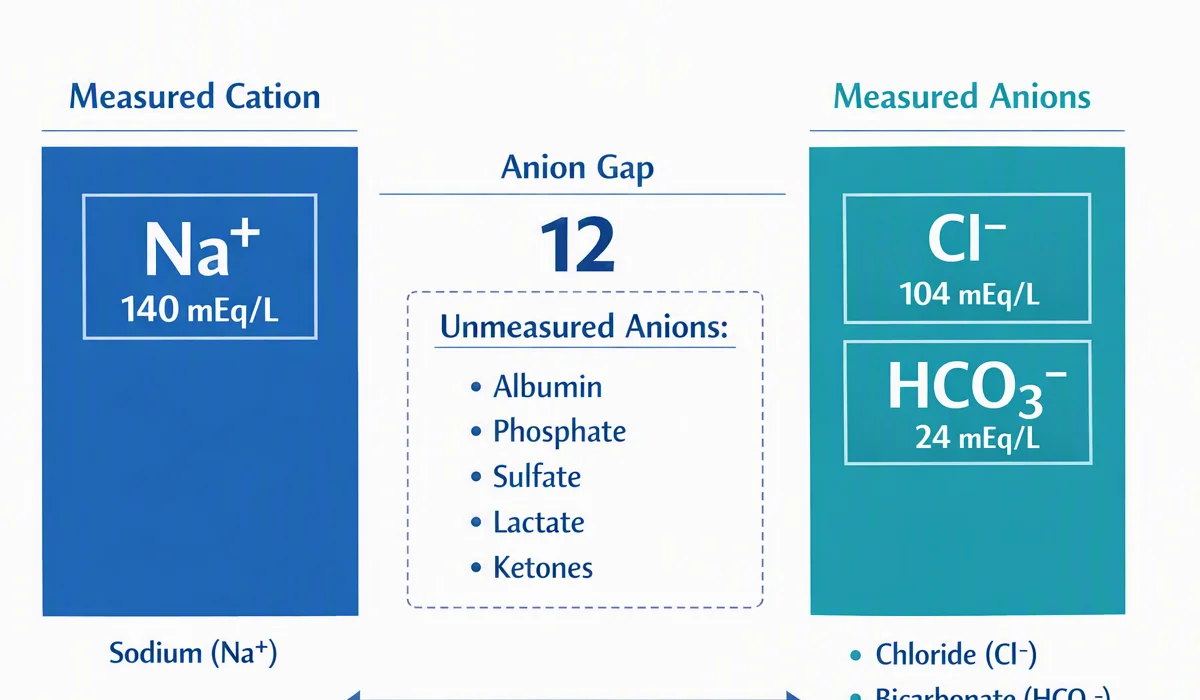
Key considerations to consider include:
- Review the albumin level and evaluate the corrected gap Examine the serum chemistry panel for chloride and bicarbonate trends Verify the acid-base status with arterial blood gas results Check for evidence of compensation or a mixed disorder Apply pH and base excess to assess severity, not only the anion gap
The best approach is to treat the anion gap as one part of a broader evaluation. It supports the differential diagnosis, but it does not replace a full acid-base assessment.
Frequently Asked Questions
Can severe acidosis happen with a normal anion gap?
Yes, it can. Severe acidosis may occur even when the anion gap is normal, particularly in normal anion gap acidosis. This commonly occurs when bicarbonate is lost or when chloride increases to compensate for the drop in bicarbonate. The patient can still be significantly acidotic even if the gap is within the normal range.
Which conditions lead to normal anion gap metabolic acidosis?
Common causes include diarrhea, renal tubular acidosis, and other sources of bicarbonate loss. Retained chloride can likewise cause this pattern. These conditions usually produce hyperchloremic acidosis with a normal or nearly normal anion gap.
How does albumin affect the anion gap interpretation?
Albumin is a major unmeasured anion, so low albumin can make the anion gap look falsely normal. Albumin correction helps uncover the true corrected gap. This is particularly important when the clinical picture points to more severe metabolic acidosis than the initial value suggests.
Can ketoacidosis or lactic acidosis present with a normal anion gap?
Yes, they can. While ketoacidosis and elevated lactate usually produce high anion gap acidosis, the gap can appear normal in a mixed acid-base disorder or if hypoalbuminemia is present. Previous bicarbonate loss or chloride loading can also hide the expected elevation.
How should an anion gap calculator be combined with blood gas results?
An anion gap calculator should be used alongside arterial blood gas results, not rather than them. The calculator helps determine whether the pattern matches normal or high anion gap acidosis, while the blood gas displays pH, base excess, and overall severity. Together, they provide a more complete interpretation anion gap clinical significance of the acid-base disturbance.